Do you believe in minimalism?
At lunchtime in Lo Lo Chai, the village had gone quiet. Doors were half open. The heat sat in the laneways. People were resting. Not because the life is easy. It is not. People here work hard. They are industrious. The day begins early. Work fills the morning, pauses for a couple of hours in the middle of the day, then begins again and continues into the early evening. There is nothing romantic about this life. It is hard. But it has its rhythms.
We are part way through our holiday in Vietnam, currently staying in Dong Van, in the far north near the Chinese border. The country here is dramatic: limestone mountains, deep valleys, narrow roads, and small villages folded into the landscape. It is beautiful, but not soft. People have lived here for centuries, including H’Mong, Tay, Dao, and Lo Lo communities, making a life in country that does not appear to make life easy.
We had lunch at Lo Lo Chai Village, not far from the Lũng Cú Flag Tower. It is home to the Lô Lô people, one of Vietnam’s ethnic minorities. Many of the houses are traditional rammed-earth homes, with thick walls and tiled roofs. There is a strong sense of culture being preserved as a lived reality.
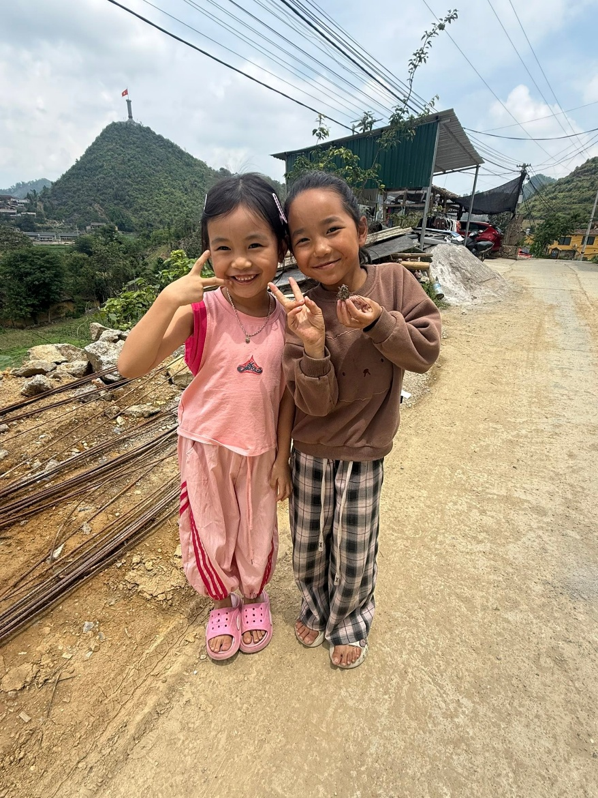
On the way to lunch, a couple of young girls came out to say hello and practise their English. They were cheerful and unselfconscious. They were happy to pose for photographs. Our group began talking about the pace of life back home. About the pressure we live under. About the strange bargain many of us have made without quite remembering when we agreed to it.
We know why we work long hours on one level. There are bills to pay. Families to support. Futures to prepare for. Responsibilities to carry.
But there is another answer too. More. More money. More comfort. More achievement. More recognition. More security. More options. And maybe none of these things are wrong in themselves. But there comes a point where “more” becomes less of a goal and more of a habit. The harder question is not, “Can I have more?” The harder question is, “When is enough?”
There is a difference between choosing less and having less chosen for you. It would be unfair to romanticise village life from the position of a traveller passing through. A slower rhythm is not necessarily an easier life. Fewer possessions do not automatically mean fewer worries.
Still, places have a way of asking questions we avoid at home. Lo Lo Chai asked one of those questions. What am I actually striving for?
I have been thinking about this for a long time. I am preparing for a life with less. Less space. Fewer things. Fewer demands. Fewer claims on my time. Some of this is practical. Some of it comes with age. Some of it is simply the next season of life. But I also hope it is more than that. I hope it is a way of learning to live simply.
Minimalism can sound like a design choice: bare walls, clean benches, neutral colours, and no visible clutter. But I do not think that is the heart of it. At its best, minimalism is not about emptiness. It is about making room for what matters. It is about asking whether the things we keep adding to our lives are actually helping us live.
Perhaps minimalism is simply learning to say: this is enough. Not because there is nothing more. But because more is not always better.


 The Afterword
Leave a comment