What is a moment in your life that felt like it was straight out of a movie?
On the flight to Vietnam, a family sat behind us: a couple with their teenage son. My wife is a psychologist, and she noticed almost immediately that he was neurodiverse.
For much of the nine-hour flight, he repeated lines from movies and television shows. Not from Good Morning, Vietnam, but in a voice that reminded us strongly of Robin Williams in that film: quick, bright, comic, full of sudden shifts and accents.
At first, I wondered how this was going to go. Nine hours is a long time in a confined space. A voice behind your head can become very large. But something shifted. He was funny. His timing was good. His mimicry was genuinely impressive. And his parents were wonderful with him. Patient. Warm. Unembarrassed. Loving. They did not shut him down. They did not apologise for him. They helped him be in the world. So what might have felt like an intrusion became part of the journey.
It also brought Good Morning, Vietnam back into my mind. I had not thought much about that film for years. It is loud and funny and uneasy. It is about Vietnam, but it is also very much about the American experience of Vietnam: American soldiers, American music, American confusion, American grief, American guilt.
That was largely how I had inherited Vietnam too. For Australians of my generation, Vietnam mostly meant the American war. It meant returned veterans. It meant questions about whether the war had been futile. It meant images of helicopters, protest, conscription, and men coming home to a country that did not know how to receive them. Later, it also meant Vietnamese refugees arriving by boat, often met by Australians with fear rather than welcome.
Then we came to Vietnam. Not the movie. Not the war. Not the backdrop to someone else’s moral reckoning. The country itself.
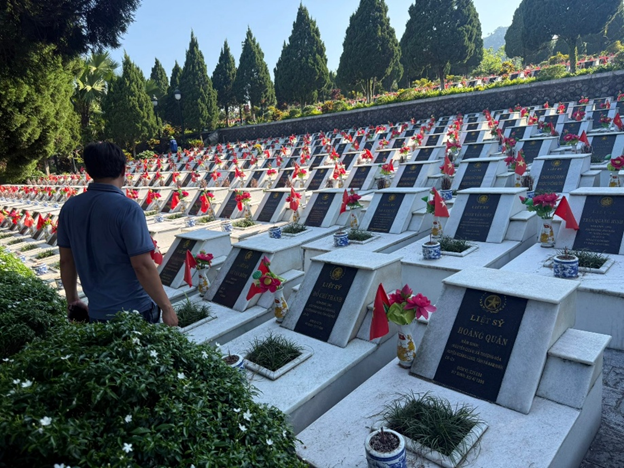
And in Hà Giang, we visited the cemetery at Vị Xuyên. There I learned about the war with China, fought along the northern border from 1979 and through much of the following decade. I was at university during those years. While I was reading books, going to lectures, worrying about essays and exams, young Vietnamese men the same age as me were dying in the mountains, defending their country before their lives had really begun.
Vietnam had already endured French colonisation, the long war with the United States, and the terrible cost of reunification. Yet even after all that, recovery was delayed by another war, another border, another generation of young men sent into danger. And somehow, for many of us, this barely registered.
There is a shame in that. Not because we could have known everything. But because our attention was so narrow. Even our concern for Vietnam was often centred on ourselves: our soldiers, our politics, our refugees, our debates, our memories. Meanwhile, Vietnamese families were burying sons whose names we never learned.
The boy on the plane had reminded me of a movie. The movie reminded me of the way Vietnam had lived in my imagination. But the cemetery corrected me.
Vietnam is not a symbol for other nations’ mistakes. It is not simply the place where Americans and Australians lost their innocence. It is a country with its own memory, its own grief, its own courage, and its own dead.
At Vị Xuyên, the graves were not part of a film. They were young lives. Students who never finished. Sons who never came home. Futures that stopped in the mountains.
And perhaps one gift of travel, when we let it do its work, is that it exposes the limits of what we thought we knew. It shows us the stories that were happening while we were looking elsewhere.


Leave a Reply