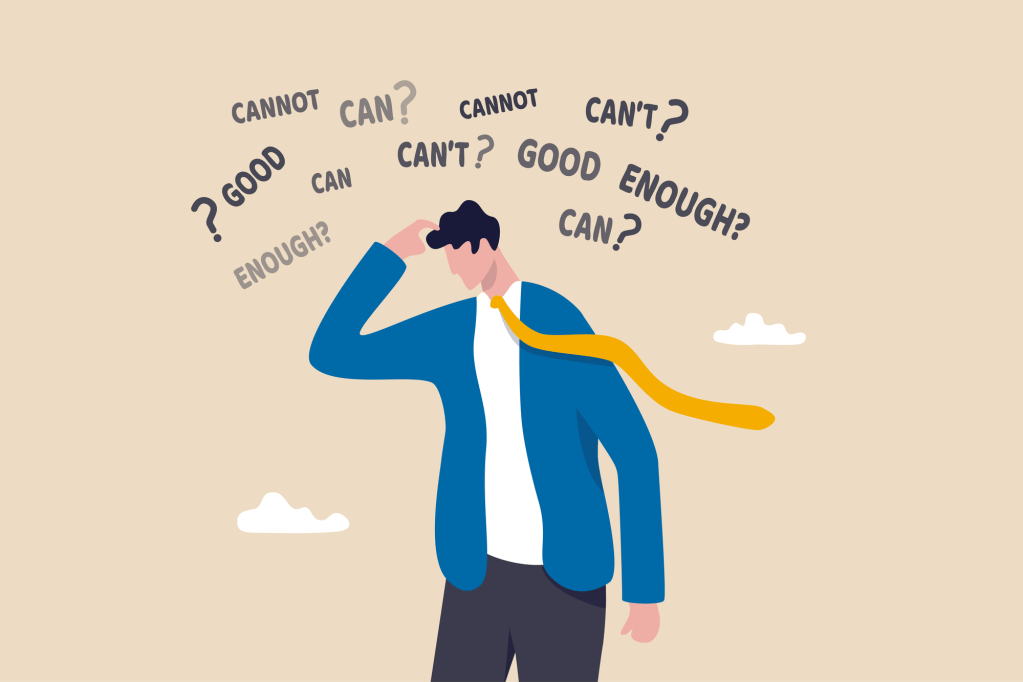
How do you handle fear and self-doubt?
I have faced plenty of self-doubt over the years, mainly in the form of imposter syndrome.
When I started my doctorate, I had a nagging sense that I would be found out. I felt as though they had let me in by mistake. Not a clerical error, but an error of judgement. Someone had thought I was capable of doing the work, and I was not sure they were right.
That feeling never fully went away. At some point I realised this was part of the process. I was wrestling with an important research question, but I was also wrestling with a question inside myself: am I equal to this?
I did not have a magic formula. I had a good supervisor who encouraged me, and that helped. But the internal work was still mine to do. The thesis was not a great one, but I learned a lot. More importantly, I kept going. When I eventually graduated, it was an incredibly exciting experience.
Shortly after that, I received a promotion I had not expected and was not looking for. I was asked to take on an executive role. I was flattered, but I felt unprepared. It was a steep learning curve, and again I wondered whether they had made a mistake.
This was not vanity anxiety. I was not mainly worried about looking foolish or being exposed as unimpressive. It was a responsibility-based fear. What if I am not equal to the task? What if I have been trusted with something I cannot carry well?
I grew a lot in that role. I made mistakes. I made things happen. I learned on the job. But I also kept looking for the gaps. I am not really a “fake it until you make it” kind of person. If there is a gap in my knowledge or skill, I would rather know what it is and deal with it.
So I did further study in tertiary management. It was one of the best things I ever did. It gave me language, frameworks, and confidence. It also became a good stepping stone to my current role, where I feel more comfortable.
So how do I handle fear and self-doubt?
I listen to fear, but I don’t let it lead.
Fear is not always accurate.
Fear is not always useless.
Fear does not have to stop you.
Sometimes fear exaggerates. Sometimes it says, “You cannot do this,” when the truth may simply be, “You cannot do this yet.”
But sometimes fear is useful. It can point to something that needs attention. It can remind me that the task matters. It can keep me humble and teachable.
So I try to listen to fear without obeying it automatically. I ask what it may be trying to protect. Is it protecting my ego, or the responsibility I have been given? Is it just anxiety, or is there something I need to learn?
When fear identifies a gap, I try to deal with the gap.
When fear is just making noise, I try to keep going.
I do not think courage usually feels like confidence. Often it feels like continuing while uncertain. Asking for help. Doing the work. Learning what I need to learn. Taking the next step before I feel completely ready.


Leave a Reply