What’s a quote that perfectly describes your outlook on life?
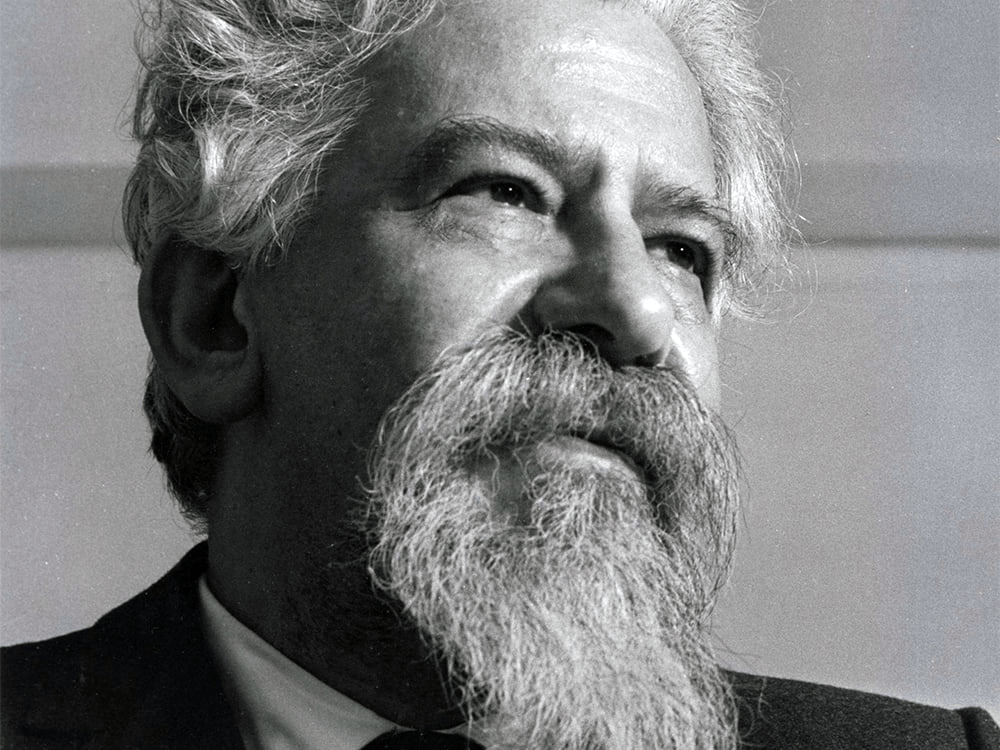
Abraham Joshua Heschel once wrote: “It is not enough for me to ask questions; I want to know how to answer the one question that seems to encompass everything I face: What am I here for?”
Few questions have stayed with me as persistently as this one.
Heschel’s writing has had a significant influence on my thinking, particularly his two-volume work The Prophets. He portrays the prophets not as people who predicted the future, but as people who became deeply attentive to the concerns of God. They felt the suffering of the world and understood that faith carried moral urgency.
Heschel also resisted attempts to reduce faith to something that could be entirely explained: “Evaluating faith in terms of reason is like trying to understand love as a syllogism and beauty as an algebraic equation.”
As someone who began in mathematics and later moved into theology, ministry and education, I find that deeply compelling. I value reason, but the most important realities cannot be contained within an argument. Love can be analysed, but analysis is not love. Beauty can be described, but the description is not the experience. Faith must be thought about, but it must also be lived.
For Heschel, religion does not begin with our search for God. It begins with God’s search for us. The important question is not merely, “What do I believe about God?” but, “How will I respond to the God who is interested in me?”
That gives the question “What am I here for?” a different character. It is not simply an invitation to discover a satisfying career or construct a private sense of purpose. It is a summons to become God’s partner in the world. Compassion needs someone willing to act. Justice needs people prepared to pursue it. God’s concern for the world seeks expression through human lives.
Perhaps that is why I love the story of Heschel and Rabbi Wolfe Kelman walking home together from the Jewish Theological Seminary. When they reached Heschel’s apartment building, Heschel would continue walking another half-mile to Kelman’s home so they could keep talking. Kelman would then turn around and accompany Heschel home again. Neither wanted the conversation to end.
There is something of Heschel’s whole philosophy in that story: truth discovered through friendship, ideas explored in relationship, and the willingness to accompany another person further than necessity requires.
Perhaps this is how we answer the question “What am I here for?” It is through the way we live: by attending to God, taking the suffering of others seriously, accepting responsibility for the world, and walking with people a little further than necessary.


 The Afterword
Leave a comment