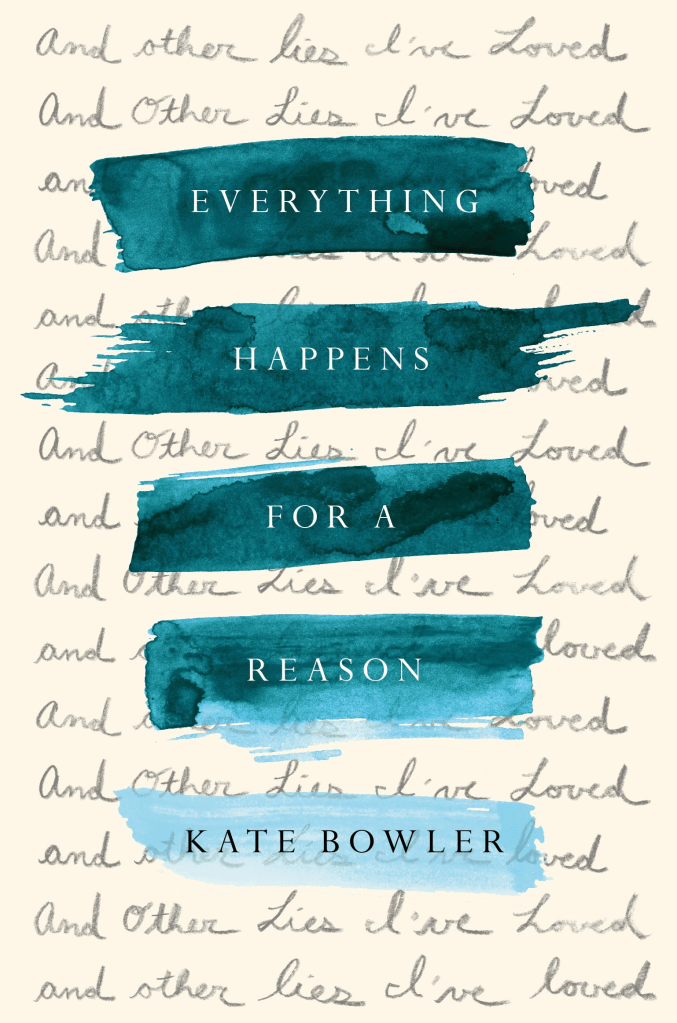
Do you think everything happens for a reason?
I have written before about Kate Bowler, the Duke University professor whose doctoral research examined the North American church’s obsession with wealth, health and success. Then, while still a young academic, she found herself living inside the questions she had studied. She was diagnosed with Stage 4 cancer.
Out of that experience came her book Everything Happens for a Reason: And Other Lies I’ve Loved. It is funny, candid and, at times, incredibly raw. Bowler never loses her eye for the absurd, but neither does she soften the cruelty of what people sometimes say to those who are suffering.
Perhaps the insistence that suffering must have a reason tells us more about the observer’s fear than about the sufferer’s life. We want the world to make sense. We want it to be orderly, predictable and fair. We want good choices to produce good outcomes, faith to guarantee protection and suffering to be traced back to some identifiable failure. If we can explain why tragedy happened to someone else, we can reassure ourselves that it will not happen to us.
And so a person’s illness becomes a puzzle to solve. Was there unconfessed sin? A lack of faith? A failure to forgive? The wrong attitude? The wrong words? The sufferer is no longer simply a person in pain. They become evidence in support of someone else’s worldview.
Bowler describes a spiritual universe governed by neat laws of cause and effect. Follow the rules and you will prosper. Break them and you will suffer. Such a system appears to make the world fair, but it does so at a terrible cost. It leaves no room for undeserved pain. It has no language for tragedy.
Perhaps that is why we cling to explanations. We are afraid to admit that terrible things can happen to faithful people. We are unwilling to stare mortality in the face. We would rather blame the person who is suffering than confront the poverty of a worldview that cannot accommodate grief, uncertainty or death.
Sometimes explanations are not acts of compassion. They are acts of self-protection. They allow us to keep our distance. They spare us from sitting quietly beside someone whose pain we cannot fix. They enable us to speak when silence would be more honest.
Faith does not require us to pretend that everything terrible is secretly good. Nor does hope require us to know why something has happened. We may believe that God is present in suffering, that grace can emerge within it and that nothing is beyond redemption, without claiming that the suffering itself was necessary.
Bowler writes that when someone is drowning, the only thing worse than failing to throw them a life preserver is throwing them a reason. That may be the better question when we encounter another person’s pain. Not, “Why did this happen?” but, “What might keep them afloat?” A meal. A phone call. Practical help. A willingness to listen. A prayer without explanations. The courage to say, “This is terrible, and I am not going anywhere.”
We do not need to solve suffering before we respond to it. Sometimes the most truthful thing we can offer is not a reason, but our presence.


 The Afterword
Leave a comment