What is the meaning of life?
At the beginning of the year I sat with a student who was trying to decide whether to change degrees. He had come to the college office after lunch and had waited near the doorway until I looked up from my desk. He said he only needed five minutes. People usually say that when they need more.
He sat down and told me he was not sure he was in the right course. His parents wanted one thing. His marks suggested another. His friends all seemed to know what they were doing. He had gone online and read about career pathways and graduate salaries and postgraduate options until the words began to lose their meaning. He said he did not want to waste his life.
I remember that phrase because he said it quietly.
There are many versions of that conversation. Sometimes it is about a course. Sometimes it is about a relationship. Sometimes it is about faith, or family, or money, or the fear that everyone else has been given a map and you missed out.
I work with university students, so I hear the question often, though it is not always asked directly. What is the meaning of life? What am I meant to do? What matters? What should I give myself to?
When those questions come, I often think of Ecclesiastes.
Ecclesiastes tells of a king who had the chance to try almost everything. He had money, power, intelligence, opportunity, and time. He gave himself to pleasure, work, wisdom, beauty, achievement, and building projects. He tested the things most of us still test, only on a larger scale.
The strange thing is that Ecclesiastes does not say those things are worthless. That would be simpler, but less true. Work matters. Pleasure matters. Wisdom matters. Beauty matters. Friendship matters. A good meal matters. A completed task matters. The choices we make matter. The days we are given matter.
But none of them is God.
Everything matters, but nothing finite can satisfy an infinite hunger.
That is where we often become disappointed. We ask work to tell us who we are. We ask love to save us. We ask pleasure to keep us happy. We ask achievement to make us permanent. We ask knowledge to give us peace. These are good things, but they cannot bear that kind of weight.
Ecclesiastes says God has “set eternity in the human heart.” I have always thought that was one of the truest lines in Scripture. We live in time, but we want more than time. We enjoy beauty, but beauty makes us want a beauty that will not pass away. We love people who cannot stay. We build things that will one day be gone. We have moments so good we want them to hold still, but they do not.
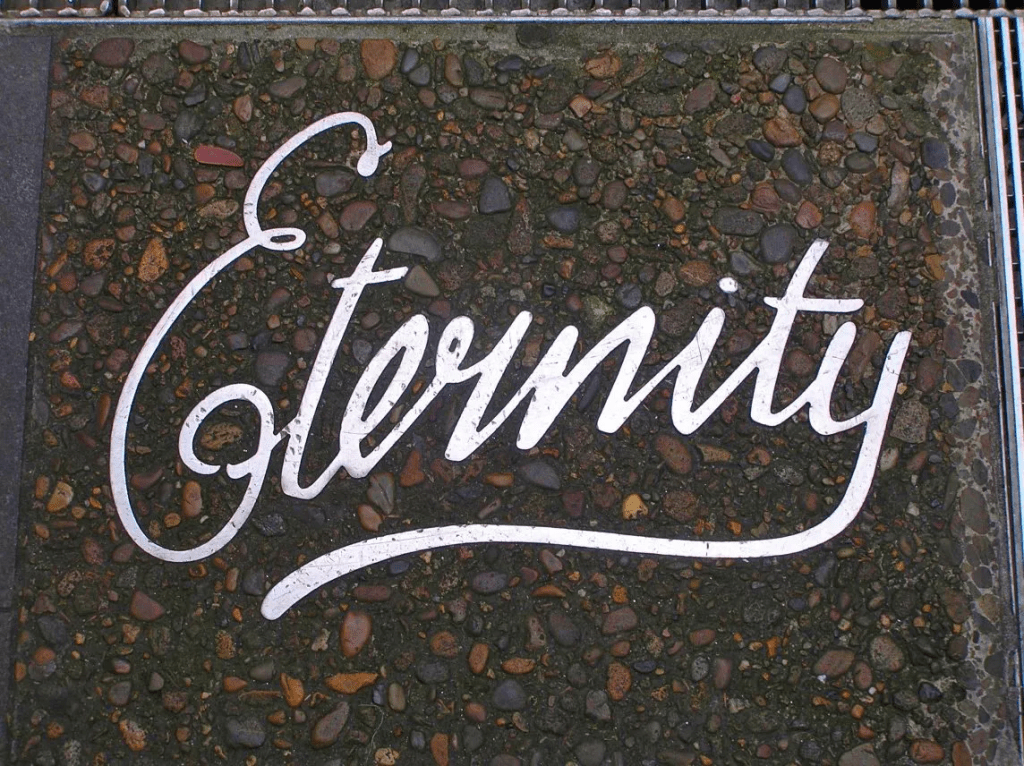
Arthur Stace wrote the word “Eternity” in chalk on Sydney footpaths for decades. People saw it on their way to work, on their way to lunch, on their way home. They stepped over it in Martin Place and other parts of the city. One word underfoot, in the middle of ordinary life.
Eternity.
It was not an argument. It was a reminder.
This is why I also return to the Sermon on the Mount. Ecclesiastes tells the truth about the exhaustion of trying to grasp meaning for ourselves. Jesus shows the shape of a life received from God. A life of mercy, truthfulness, forgiveness, humility, prayer, generosity, trust, and love. A life built on rock.
The meaning of life is not found by forcing eternal weight onto things that cannot carry it.
It is found by receiving what God has to give, and then entering life with less desperation and more joy.
Work faithfully. Love people. Tell the truth. Eat together. Take the walk. Answer the email kindly. Sit with the student who says he only needs five minutes.
Everything matters.
But nothing finite can satisfy an infinite hunger.


Leave a comment