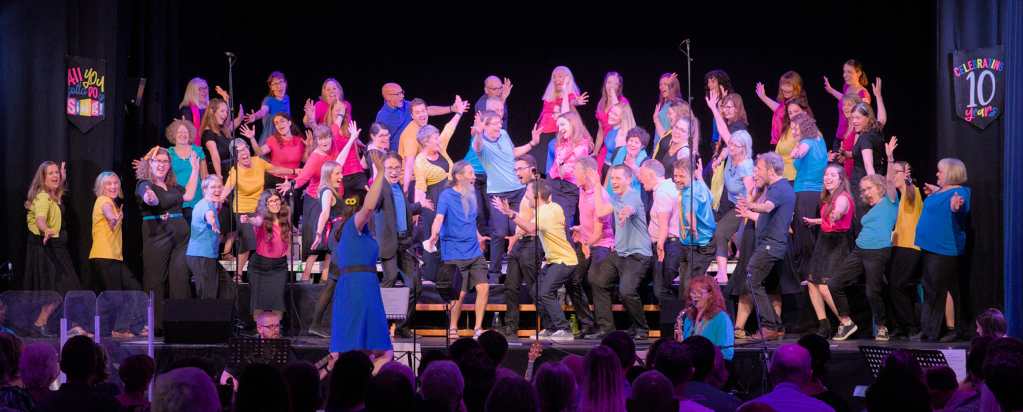
Sometimes the people we need most are the ones we’ve never met before.
There’s something oddly tender about the first conversation you have with a stranger—especially when it happens in a room full of strangers, where no one yet knows how the story will go. That first confession, “I’ve never done this before,” offered by the woman beside me in the alto section, carried something holy in it. Not in its content, perhaps, but in its courage. And maybe, without realising it, I answered with a kind of liturgy: “We’ll be fine.” A gentle lie, or a fragile faith—sometimes they’re not so different.
I hadn’t come to choir to find friends. I came because, after a year of silence, something inside me wanted to sing. I came because the weight of absence had become too familiar. I didn’t expect to find company in my uncertainty. I didn’t expect the woman beside me to speak, and I certainly didn’t expect her to become the first echo of something I didn’t know I was listening for: permission to try.
The room was full—of sound, of nerves, of stories like mine and not like mine at all. What brought us together wasn’t just the desire to sing, but the strange grace of shared incompleteness. And in that shared lack, we offered each other the smallest of gifts: a voice, a glance, a harmony, a breath.
I’d loved before. I’d been loved. And I’d lost. What I hadn’t expected was that strangers—these voices unknown to me—could help return something of that love to me, not by replacing it, but by honouring its shape through sound. Somehow, in the weaving of voices around Psalm 137, we built a structure that could hold grief and beauty at the same time. I didn’t know that was possible.
That’s the gift of strangers. Not because they stay strangers, but because they arrive as strangers. They don’t ask for your story. They simply make space for it. They make music with you without needing to understand what it means to you. And somehow, by doing so, they become part of it.
We often think healing comes from those who know us well. But sometimes, it begins with someone who doesn’t. Someone who leans in and admits, “I don’t know how to sing,” and invites you to stand with them anyway.
And in the fragile, half-sure beauty that rises from there, something old and precious is restored—not fixed, not solved, but reawakened. In harmony. In company. In the gift of strangers who are no longer entirely strange.
She leaned in—
“I’ve never done this before.”
Neither had I,
but I said we’d be fine.
The room was too big
for certainty,
filled with strangers
and stories unsaid.
I carried grief
like a folded note—
thirty years of harmony
now silent.
By the rivers of Babylon
When we sang wept
and remember,
my voice found hers,
and hers found mine,
and the air
held us both.
We sang.
I wept.
And strangers became
a kind of home.


 The Afterword
Leave a comment