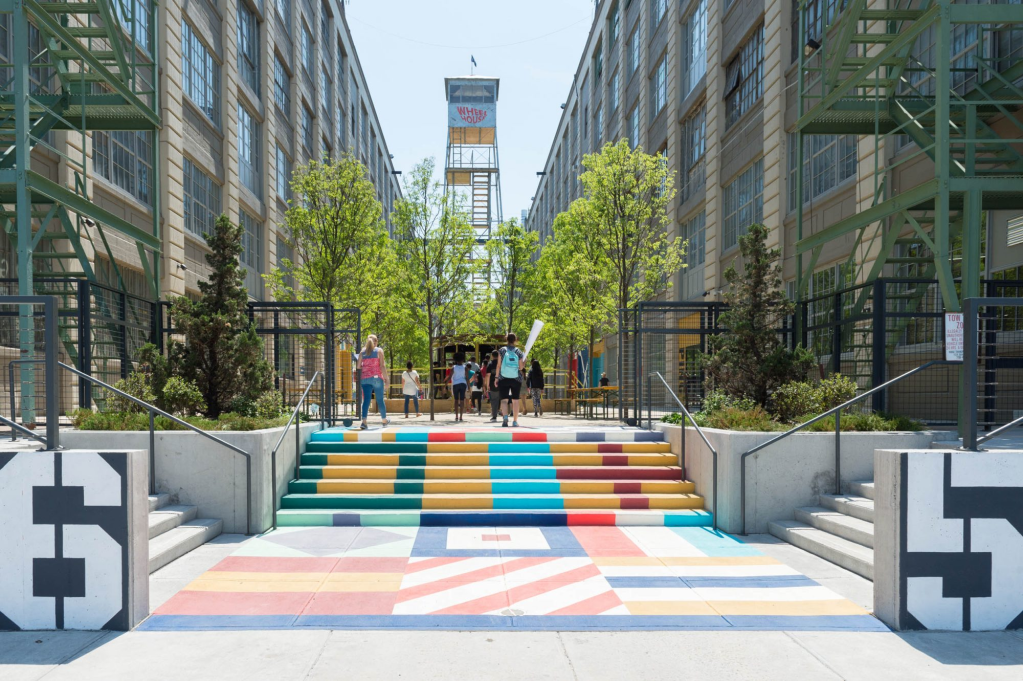
When you step out the door in this city, you don’t face traffic. You face a courtyard. Each cluster of apartments, terraces, or townhouses opens inward, toward a green square where people naturally meet. Streets and cars exist, but they’re pushed to the edges. The courtyard is the neighbourhood’s beating heart.
During the day, children play in sight of a dozen balconies, parents catch up over coffee from the shared kitchen kiosk, and older residents wander down for a slow game of chess. Some courtyards have half-courts for basketball or futsal; others feature built-in amphitheatres, workshop spaces, or open walls that rotate between murals and community art projects. In the evenings, those same spaces turn into venues: a small stage for music, a screen for outdoor films, or simply room for a poetry slam or open-mic night.
Funding and Governance
Each courtyard operates as a commons. Residents contribute a levy—similar to strata or council rates—that funds maintenance, equipment, and shared events. Larger-scale support comes from a mix of city funding and local partnerships: cafés lease corner spaces, arts organisations co-host performances, sports clubs maintain equipment.
Safety and Trust
Safety isn’t left to chance. Courtyards are built with visibility: no blind corners, no neglected spaces, every play area overlooked by homes. Clear community guidelines are co-written by residents and displayed where everyone gathers. By design, anonymity is reduced; people know their neighbours, and accountability flows from relationship as much as from regulation.
Events and Spontaneity
There’s a rhythm to communal life. Each courtyard has a volunteer committee (changing every year) that coordinates regular events: Friday night concerts, seasonal food festivals, monthly kids’ theatre, weekly sports tournaments. But alongside planned activities, architecture itself encourages spontaneity: stages that don’t need bookings, storage lockers with shared instruments and sports gear, open walls for art, flexible lighting systems that let a simple courtyard turn into a venue in minutes.
The Network Effect
These courtyards are not isolated. They’re stitched together into a city-wide fabric: pedestrian and cycling routes lead from one courtyard to the next, plazas open up where several clusters meet, and the whole city breathes like a living network. It’s possible to walk across the city moving from community to community, always through shared life before private retreat.
In this prototype city, the future isn’t just about smart technology or sustainable energy—though those matter. It’s about designing for belonging. Streets move cars; courtyards move people toward one another. Art and sport are not extras, but the very framework of civic life. And safety is not the job of distant authorities, but the practice of neighbours who care for the spaces they share.
This isn’t utopia—it’s simply a different blueprint. One where the city itself insists: you don’t have to live alone in a crowd.


 The Afterword
Leave a comment