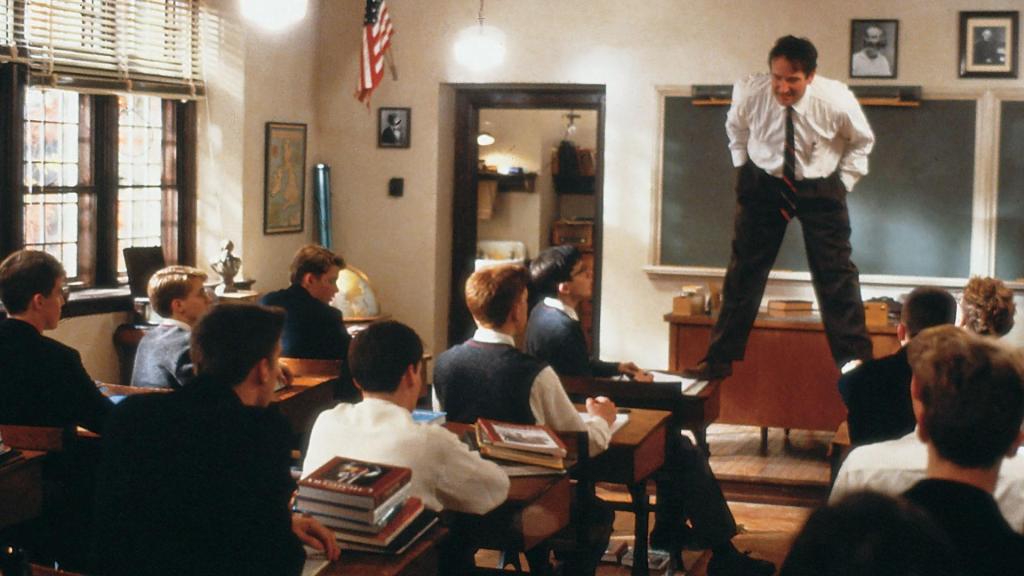
If I could step into the shoes of any character from a book or film, I’d be tempted to choose John Keating from Dead Poets Society. Robin Williams brings him to life with that inimitable, twinkling mischief in his eye—the kind of teacher who walks on desks, encourages rebellion with flair, and dares students to rip pages out of their textbooks. What’s not to love?
I adore that scene, of course. The one where he tells the boys to tear out the introduction that reduces poetry to a formula. It’s funny, theatrical, and bold—but beneath the drama is something far more profound: an invitation for students to think for themselves. To feel their way into learning. To discover that education isn’t a system to submit to, but a lifelong adventure of curiosity and voice-finding.
And yet… I don’t actually want to be John Keating.
Not really.
For one, there’s only one Robin Williams. Trying to replicate Keating would feel like performing a pale imitation of someone else’s authenticity. And that’s the irony, isn’t it? A character who urges others to find their own voice should never become a mould to imitate. To mimic Keating would be to miss his point entirely.
I’m not here to deliver “captain, my captain” moments. I’m here to do something less cinematic, but no less important. I want to walk alongside students as they learn how to learn. To trust their instincts, to reflect deeply—not just on success, but also on their missteps—and to become people of substance and courage.
Parker Palmer, in The Courage to Teach, speaks to my core. He writes about three kinds of learning—teacher-centered, student-centered, and subject-centered. The first prizes expertise but often neglects engagement. The second celebrates curiosity but risks losing the anchoring wisdom of tradition. The third, subject-centered learning, is where I find my home.
Here, the subject—the great, living mystery of what we are trying to understand—holds us all in its orbit. Teacher and student alike are learners. We each bring something: experience, questions, hunches, stories. And we are changed together as we engage, not with formulas, but with wonder.
Keating’s classroom was electric. But my classroom—if I’m doing it right—is a place where silence is allowed. Where a question can hang in the air without needing an immediate answer. Where a student can bring something raw, unshaped, ungraded—and it is received with seriousness. Where the subject teaches us all.
So no, I don’t want to be John Keating.
But I do want to rip out the introduction.
I want to make room for learning that breathes. For learning that has a pulse. For learning that dares to go off-script—not for the sake of rebellion, but for the sake of truth.
And that kind of teaching doesn’t require charisma or a desk-top monologue. It just requires me—to show up fully, with integrity, in the classroom. To be present. To be real.
And to help students find their way—not to me, not to their true selves, but to something more important.
Carpe Veritatem
I don’t want to be
the man on the desk,
shouting truth
into the silence.
I love him—
his fire,
his page-ripping passion.
But I am not
a performance.
I teach in quiet ways—
through presence,
through space,
through questions
that take time to bloom.
Let the subject
be our sun.
Let us orbit it,
drawn into wonder,
each finding warmth
in different light.
No, I don’t want to be John Keating.
But I do want
to carpe veritatem—
to make the most of the subject,
and let it shape
us all.


 The Afterword
Leave a comment